
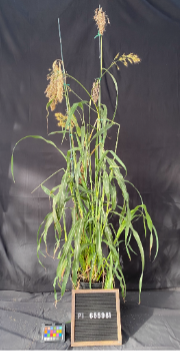
Sb bicolor PI655981 SAP-50 Assembly and Gene Annotation
About Sorghum PI655981
Sorghum (Sorghum bicolor [L.] Moench) is a drought-tolerant, warm-season C4 grass cultivated globally for grain, forage, and bioenergy applications. It is a flagship species for genomic research due to its relatively small, diploid genome and extensive germplasm resources.
The PI_655981 accession is one of 32 diverse sorghum lines selected for de novo genome assembly as part of the Sorghum pan-genome project. This line contributes to capturing global genetic diversity and supports investigations into presence–absence variation, copy number variation, and structural genomic diversity relevant to agronomic and bioenergy traits.
Other name(s): CSM-63, 87C424
Species: Sorghum bicolor subsp. bicolor
Group: ICRISAT Reference Collection, Sorghum Association Panel & Bioenergy Association Panel
Flowering Days Under Short Days: 47 days after planting
Seed Color: Brown-Purple
Seedling Color: Green
Mid-Rib Color: White
Lodging: Yes
Stem diameter (mm) 3rd internode: 6.6
Stem diameter (mm) 6th internode: 4.0
Main Stem Height: LC; PD (cm): 130; 27.5
Total Number of Tillers, with panicles: 16, 9
Tiller 1 Stem Height: LC; PD (cm): 109; 13
Tiller 2 Stem Height: LC; PD (cm): 116; 16
Tiller 3 Stem Height: LC; PD (cm): 108; 21
● Stem diameter: recorded both axes means. if oval-shaped "x, y".
● Measurements highlighted in green and photos were recorded 18 weeks after planting (WAP).
● Growth conditions: 28°C (day)/22°C (night); 16h light:8h dark; Light Intensity: 400 uMol, 50% RH, Soil type: Berger BM7.
● The plant was measured up to the last collar (LC) as well as the peduncle to the base of the panicle (PD). Before panicle formation, the height was measured up to the top of the tallest leaf (TTL).
Assembly
The Sorghum bicolor PI_655981 genome was assembled using long-read PacBio sequencing data and polished using RACON. Assembly refinement included correction of misjoins, chromosome scaffolding using syntenic markers, and haplotype collapsing. Final assemblies consist of 10 chromosomes and were screened for contaminants and corrected using Illumina short reads.
Assembly Statistics (PI_655981)
Assembler: Canu
PacBio Coverage: 97.75×
Average Read Size: 14,721 bp
Assembly Breaks: 2
Assembly Joins: 85
Collapsed Alternative Haplotypes: 31
Illumina Coverage: 11.9x
These metrics indicate a high-coverage, well-resolved genome assembly suitable for pan-genome analyses.
Annotation
Gene annotation for Sorghum bicolor PI_655981 was performed as part of a two-round pan-genome annotation strategy.
In the first round, transcript assemblies derived from Illumina RNA-seq data were generated using PERTRAN and PASA. Homology-based gene prediction methods included FGENESH, FGENESH_EST, EXONERATE, AUGUSTUS, and PASA-derived ORFs. Predictions were filtered based on transcript support, protein homology, repeat overlap, and domain composition.
In the second round, high-confidence gene models were propagated across the pan-genome using homology-based predictions from other sorghum genomes. Low-confidence, repetitive, or weakly supported models were removed to generate a refined gene set.
Regulation
Variation
Key references supporting the Sorghum pan-genome project include:- Paterson et al. (2009). The Sorghum bicolor genome and the diversification of grasses. Nature.
- Hickey et al. (2020). Genotyping structural variants in pangenome graphs using the vg toolkit. Genome Biology.
- Song et al. (2022). AnchorWave: sensitive alignment of genomes with high sequence diversity. PNAS.
- Li et al. (2022). Plant pan-genomics: recent advances, new challenges, and roads ahead. Journal of Genetics and Genomics.
Links
More information
General information about this species can be found in Wikipedia.
