

Sb bicolor R931945-2-2 Assembly and Gene Annotation
About Sorghum R931945-2-2
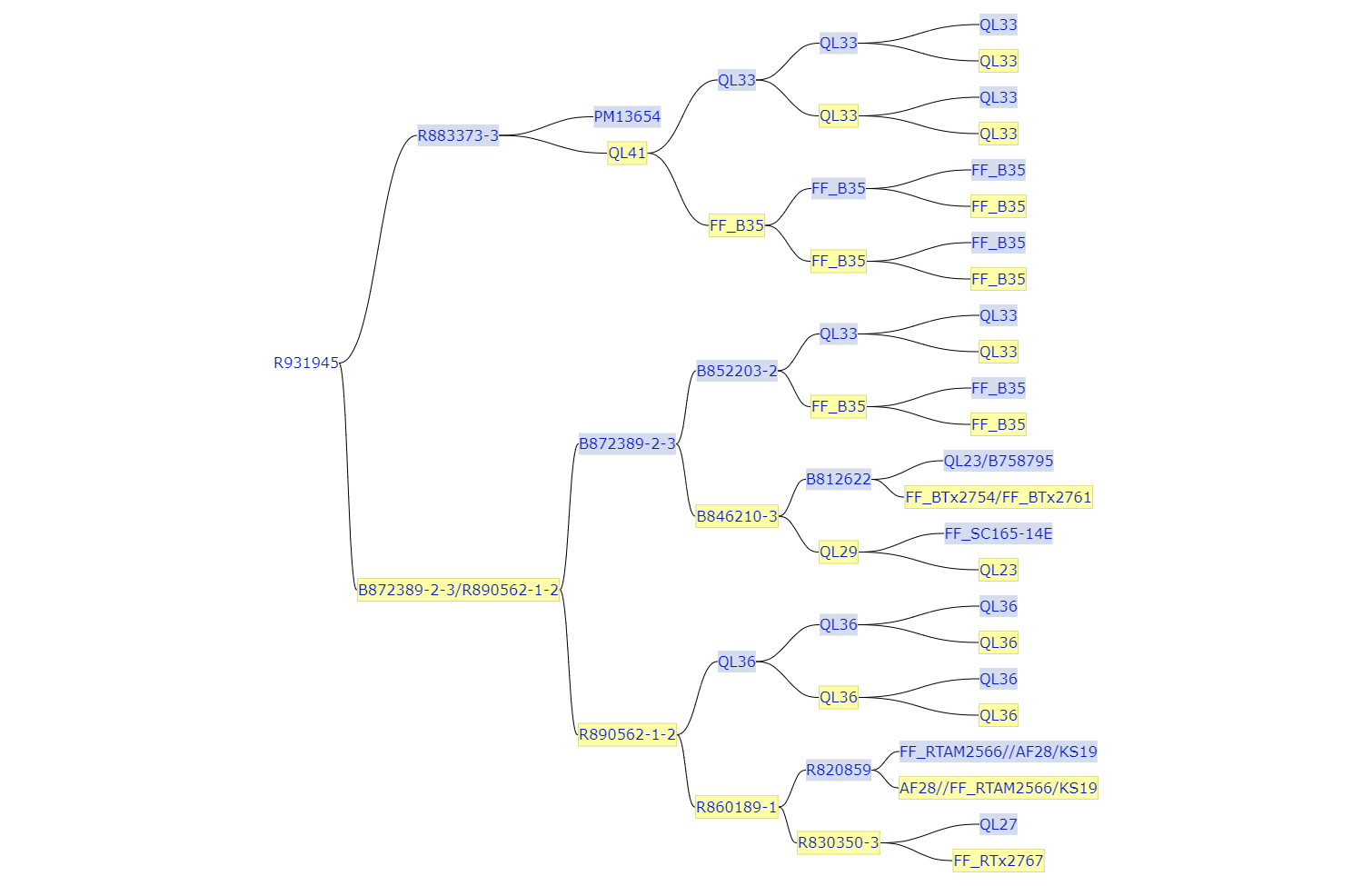
R931945-2-2 is an S.bicolor breeding line developed and owned by the Queensland Government, Australia. It is the product of successful selection to develop lines with resistance to sorghum midge and stay-green type drought resistance. It is a restorer of fertility in the A1 male-sterile cytoplasm. R931945-2-2 has a complex pedigree that includes the stay-green donor, Tx642, at several points and multiple donors of midge resistance including TAM2566, SC165-14E, AF28 and BTx2754.
R931945-2-2 has been used repeatedly as the adapted recurrent parent in the development of extensive BCNAM populations by the Australian core pre-breeding program. It has also been an important parent in the development of restorer lines in multiple commercial grain sorghum breeding programs.
Graphical representation of the pedigree of R931945-2-2:
Assembly
The genome assembly of Sorghum R931945-2-2 was reported in Tao et al, 2021. Sequencing was conducted by the Australia Sorghum breeding team in collaboration with BGI-Shenzhen using Illumina HiSeq 4000 platform and the PacBio Sequel platform to achieve 179X and 29X coverage, respectively. The assembly effort generated a genome of 599.2Mb with contigs N50 of 116.5kb.
Annotation
Gene prediction was performed using a hybrid approach combining de novo gene predictors and evidence-based methods (Tao et al, 2021), which led to the identification of 33,567 genes in the genome.
References
- Extensive variation within the pan-genome of cultivated and wild sorghum. Tao Y, Luo H, Xu J, Cruickshank A, Zhao X, Teng F, Hathorn A. Wu X. Liu Y. Shatte T et al. Nat. Plants.
- The Sorghum bicolor genome and the diversification of grasses. Paterson AH, Bowers JE, Bruggmann R, Dubchak I, Grimwood J, Gundlach H, Haberer G, Hellsten U, Mitros T, Poliakov A et al. 2009. Nature. 457:551-556.
- The Sorghum bicolor reference genome: improved assembly, gene annotations, a transcriptome atlas, and signatures of genome organization. McCormick RF, Truong SK, Sreedasyam A, Jenkins J, Shu S, Sims D, Kennedy M, Amirebrahimi M, Weers BD, McKinley B et al. 2018. Plant J. 93:338-354.
- Population genomic and genome-wide association studies of agroclimatic traits in sorghum. Morris GP, Ramu P, Deshpande SP, Hash CT, Shah T, Upadhyaya HD, Riera-Lizarazu O, Brown PJ, Acharya CB, Mitchell SE et al. 2013. Proc. Natl. Acad. Sci. U.S.A.. 110:453-458.
- Whole-genome sequencing reveals untapped genetic potential in Africa's indigenous cereal crop sorghum. Mace ES, Tai S, Gilding EK, Li Y, Prentis PJ, Bian L, Campbell BC, Hu W, Innes DJ, Han X et al. 2013. Nat Commun. 4:2320.
- A Sorghum Mutant Resource as an Efficient Platform for Gene Discovery in Grasses. Jiao Y, Burke J, Chopra R, Burow G, Chen J, Wang B, Hayes C, Emendack Y, Ware D, Xin Z. 2016. Plant Cell. 28:1551-1562.
- Applying genotyping (TILLING) and phenotyping analyses to elucidate gene function in a chemically induced sorghum mutant population. Xin Z, Wang ML, Barkley NA, Burow G, Franks C, Pederson G, Burke J. 2008. BMC Plant Biol 2008, 8:103.
- Forward Genetics by Sequencing EMS Variation-Induced Inbred Lines. Addo-Quaye C, Buescher E, Best N, Chaikam V, Baxter I and Dilkes BP. 2017. G3: Genes, Genomes, Genetics. 7(2):413-425.
More information
General information about this species can be found in Wikipedia.
More information
General information about this species can be found in Wikipedia.
