
Search
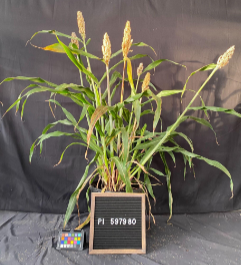
About Sorghum PI597980
Sorghum (Sorghum bicolor [L.] Moench) is a drought-tolerant, warm-season C4 grass cultivated globally for grain, forage, and bioenergy applications. It is a flagship species for genomic research due to its relatively small, diploid genome and extensive germplasm resources.
The PI_597980 accession is one of 32 diverse sorghum lines selected for de novo genome assembly as part of the Sorghum pan-genome project. This line contributes to capturing global genetic diversity and supports investigations into presence–absence variation, copy number variation, and structural genomic diversity relevant to agronomic and bioenergy traits.
Other name(s): SC 1345, CSM-90, SAP-173
Species: Sorghum bicolor subsp. bicolor
Group: ICRISAT Reference Collection & Sorghum Association Panel
Flowering Days Under Short Days: 47 days after planting
Seed Color: White
Seedling Color: Purple
Mid-Rib Color: White
Lodging: Tan
Stem diameter (mm) 3rd internode: 13.2, 11.0
Stem diameter (mm) 6th internode: NA
Main Stem Height: LC; PD (cm): 71
Total Number of Tillers, with panicles: 13, 12
Tiller 1 Stem Height: LC; PD (cm): 68
Tiller 2 Stem Height: LC; PD (cm): 82; 1
Tiller 3 Stem Height: LC; PD (cm): 79
● Stem diameter: recorded both axes means. if oval-shaped "x, y".
● Measurements highlighted in green and photos were recorded 18 weeks after planting (WAP).
● Growth conditions: 28°C (day)/22°C (night); 16h light:8h dark; Light Intensity: 400 uMol, 50% RH, Soil type: Berger BM7.
● The plant was measured up to the last collar (LC) as well as the peduncle to the base of the panicle (PD). Before panicle formation, the height was measured up to the top of the tallest leaf (TTL).
Taxonomy ID 4558


Genome assembly: Sb-PI597980-REFERENCE-JGI-1.0
 More information and statistics
 Download DNA sequence (FASTA)
 Display your data in Ensembl Plants

Gene annotation
What can I find? Protein-coding and non-coding genes, splice variants, cDNA and protein sequences, non-coding RNAs.

Comparative genomics
What can I find? Homologues, gene trees, and whole genome alignments across multiple species.